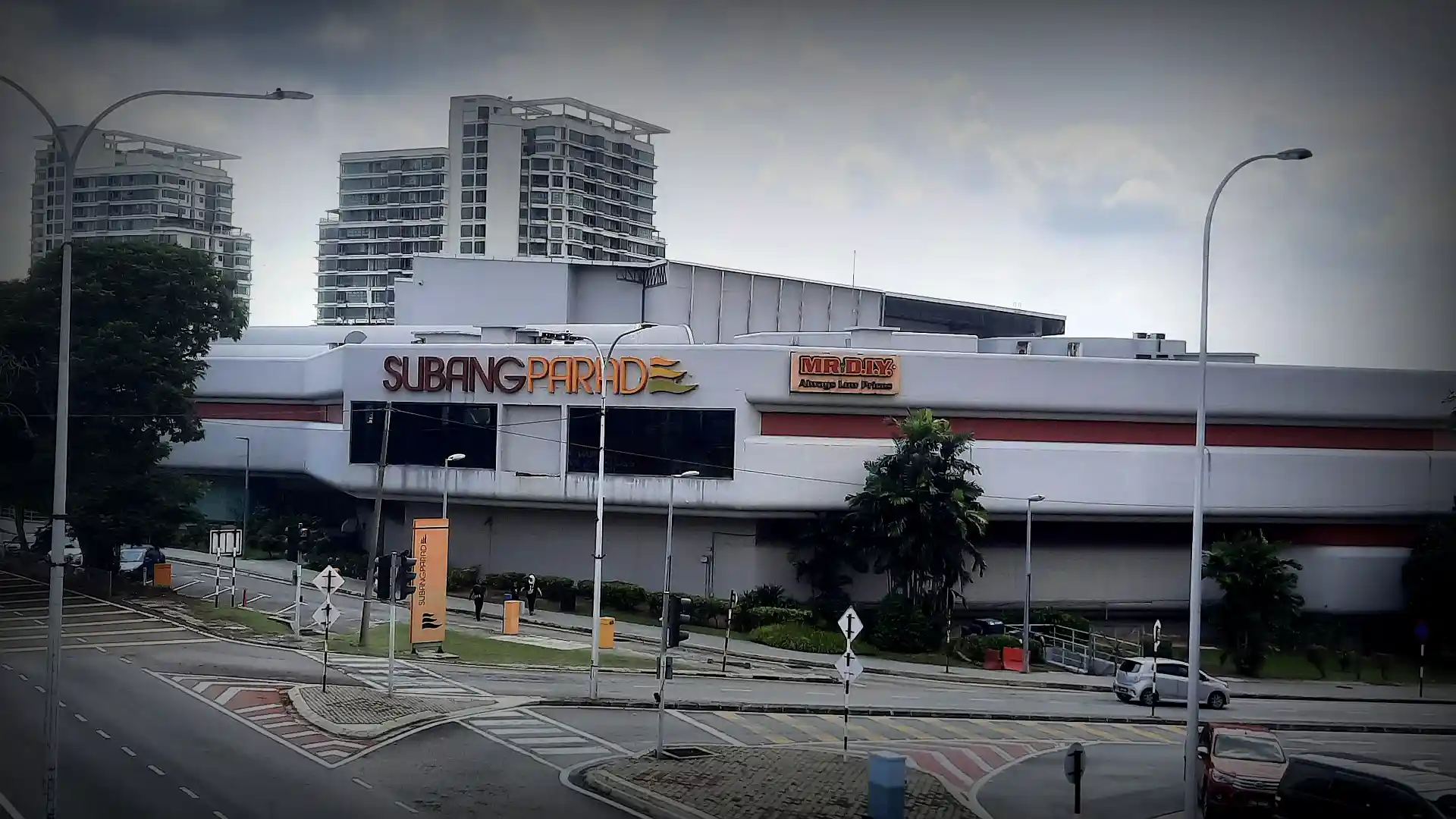
When Subang Parade opened its doors on 13 August 1988, it was the longest shopping mall in Southeast Asia.
The claim captures a moment in Malaysian retail history: the country’s first generation of suburban malls was being born, and Subang Parade — then known as Subang Jaya Shopping Centre — was at the front of the wave.
Subang Jaya itself had barely existed a decade earlier; in the late 1970s the area was oil palm plantation, and only in the early 1980s did developers begin transforming it into a township. Subang Parade was there from the beginning — a retail anchor for a brand-new suburb.
The inclusion of a shopping mall in the Subang Jaya masterplan came from Abd Aziz Mohamed, who worked at Sime UEP, the master developer.
The original owner was United Estates Projects Berhad, and the mall was managed by Natvest, a subsidiary of the Lion Group.
Collings Hui Sdn Bhd served as its first marketing agent. This was a pioneering era: the suburban mall was a new concept in Malaysia, and Subang Parade helped define what it meant.
Subang Jaya was oil palm plantation in the late 1970s. By the mid-1980s it was a new township.
The Opening Years (1988)
The mall’s first anchor tenant, Parkson Grand, opened in June 1988 — two months before the mall’s official August launch.
Its second tenant was a 30,000-square-foot Toys “R” Us outlet, opened in November 1988 as a joint venture with Metro Holdings of Singapore — the first Toys “R” Us in Malaysia.
The same month saw the arrival of J Highby’s, a frozen yoghurt chain, and on 10 December 1988, a Grandy’s outlet opened.
These early tenants tell the story of late-1980s Malaysian retail: department stores, toy superstores, and the first wave of American fast-food and frozen-dessert franchises.
The Hektar REIT Portfolio
In 2003, Subang Parade was sold to The Hektar Group, and in 2006 it was folded into Hektar REIT — Malaysia’s first retail-focused real estate investment trust dedicated to community malls.
Within the Hektar portfolio, Subang Parade sits alongside Kulim Central and Central Square (Kedah), Wetex Parade and Segamat Central (Johor), and Mahkota Parade (Malacca).
The REIT model reflects the mall’s character: it is not a trophy asset like Pavilion Kuala Lumpur or Suria KLCC, but a steady, community-serving retail destination whose value lies in consistency and catchment, not spectacle.
Location & Neighbourhood
Subang Parade sits just off the Federal Highway, one of the Klang Valley’s busiest arterial roads, making it accessible from Kuala Lumpur, Petaling Jaya, and Shah Alam alike.
It is within walking distance of several landmarks that define the Subang Jaya town centre: the Darul Ehsan Mosque, the Aeon Big hypermarket (formerly Carrefour), the upscale Empire Shopping Gallery, and the Subang Jaya KTM / LRT station.
This clustering of retail, transit, and civic landmarks makes the area a genuine town centre rather than a standalone mall — and Subang Parade is its oldest anchor.
The Mall That Stood the Test of Time
In 2022, Free Malaysia Today named Subang Parade among “5 Malaysian shopping malls that have stood the test of time.”
That recognition captures something important. Malaysia’s retail landscape is littered with malls that opened with fanfare and faded — victims of overbuilding, changing tastes, or poor locations.
Subang Parade survived because it was never a destination mall built on spectacle.
It was a neighbourhood mall built on routine: the weekly grocery run, the after-school hangout, the weekend movie, the birthday meal. These are the rhythms that keep a mall alive when trends shift.
A retiree arrives early for the pharmacy and the newsagent.
The mall’s ground floor is quiet, the fluorescent lights humming.
School lets out and the walkways fill with teenagers.
They browse fashion stalls, queue at the bubble tea outlet, claim a table at the reading corner with homework.
Families converge for the GSC Cinemas screening.
They eat at the food court first, then join the queue at the ticket counter.
Conclusion: The Heart of Subang Jaya
Subang Parade is not the biggest, the newest, or the most glamorous mall in the Klang Valley.
It is something more durable: the mall that grew up with Subang Jaya.
From its 1988 debut as the longest mall in Southeast Asia, through the Hektar acquisition, the cinema’s disappearance and return, the 2016 facelift, and the pandemic’s disruptions, it has remained the retail and social centre of its township.
In an era of mega-malls and themed retail destinations, Subang Parade’s quiet persistence is its own kind of achievement.
It is the place where Subang Jaya buys its groceries, watches its movies, does its homework, and meets its neighbours. Nearly four decades on, that is still the most important thing a community mall can be.