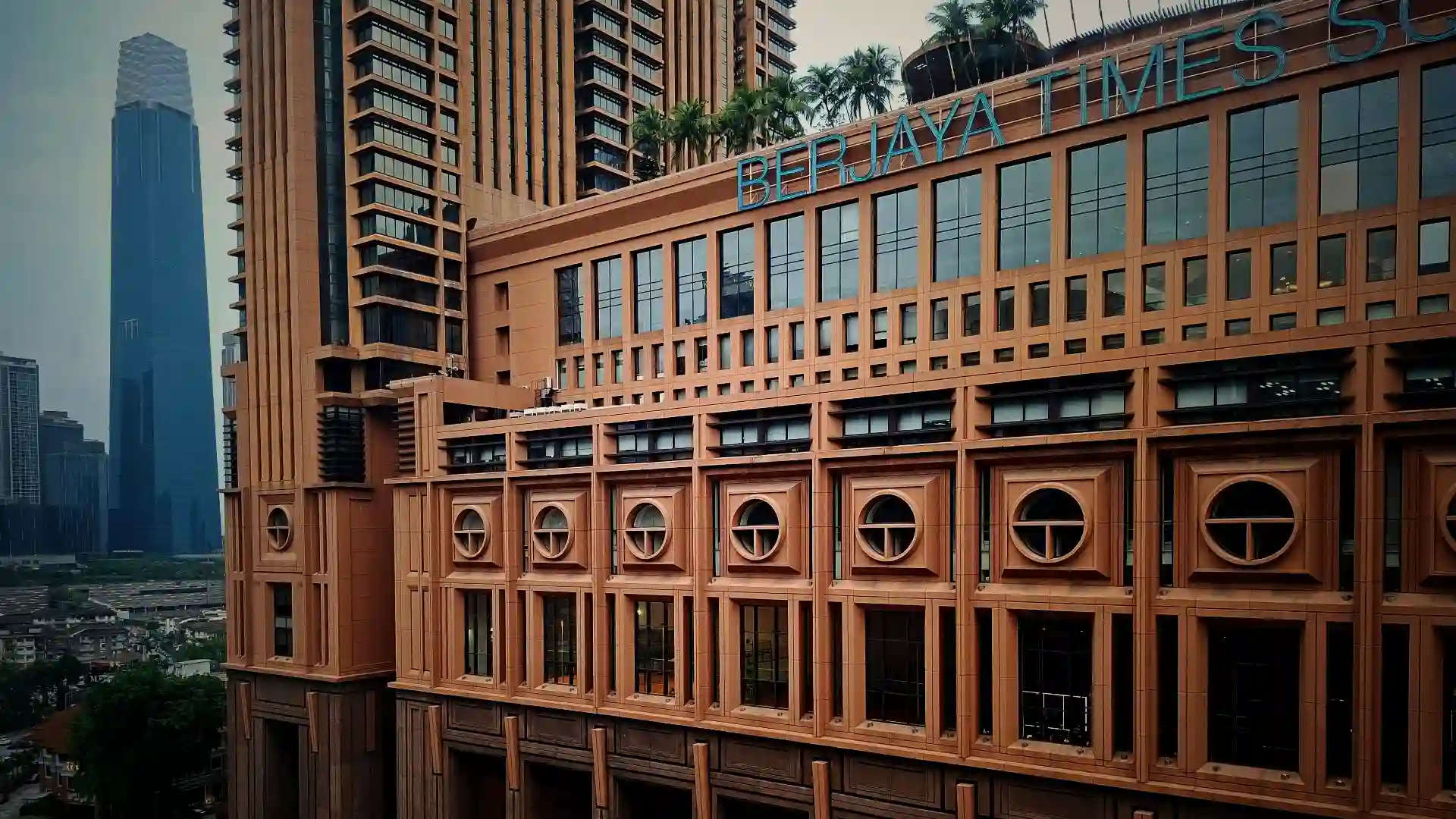
When Berjaya Times Square Kuala Lumpur opened its doors on 29 September 2003, it did not merely join the ranks of Kuala Lumpur’s shopping destinations — it announced itself as a phenomenon.
Standing 203 metres tall with 48 storeys of twin towers rising above the Bukit Bintang skyline, this extraordinary mixed-use complex at 1 Jalan Imbi is one of the most ambitious urban developments ever undertaken in Malaysia.
Comprising a shopping centre, indoor amusement park, hotel, luxury condominiums, and commercial offices all under one colossal roof, Berjaya Times Square represents a singular vision of integrated urban living.
It is currently ranked as the tenth largest building in the world by floor area and holds the distinction of being the world’s largest building ever constructed in a single phase, with a staggering 700,000 square metres of built-up floor area.
A Vision Delayed by Crisis
Delivered by Determination
The story of Berjaya Times Square is as dramatic as its architecture.
Construction began in 1997 with an ambitious vision to create a self-contained city within a building — a destination where residents, shoppers, tourists, and office workers could live, play, work, and be entertained without ever needing to venture outside.
The original opening was planned for 1999, but the devastating 1997 Asian Financial Crisis struck Malaysia with force, halting construction and casting doubt on the project’s viability.
Many similar developments across the region were abandoned or scaled back.
Yet the Berjaya Group, led by Tan Sri Vincent Tan, persevered through the crisis, completing the development with a determination that would eventually transform an entire urban district.
The land itself carries its own historical significance. Before the towers rose, the site at Jalan Imbi belonged to the millionaire and philanthropist Cheong Yoke Choy, whose bungalow stood on the parcel for decades before the Berjaya Group acquired it for development.
When Berjaya Times Square finally opened to the public, it was officially inaugurated by Malaysia’s then-Prime Minister Tun Dr Mahathir Mohamad — a ceremony that signalled not just the completion of a building, but the resilience of Malaysia’s economic ambitions in the post-crisis era.
Architectural Grandeur and Scale
Designed by the renowned DP Architects, Berjaya Times Square is an architectural statement in postmodernist style.
The twin towers — Tower A rising 49 storeys and Tower B at 48 storeys — dominate the local skyline, their mass and height creating a distinctive silhouette visible from much of central Kuala Lumpur.
The complex encompasses a 13-storey shopping podium, making the total structure one of the most vertically integrated developments in Southeast Asia. With 31 lifts serving the towers and approximately 4,300 parking bays spread across the basement levels, the building is engineered to handle enormous volumes of residents, shoppers, and visitors simultaneously.
The shopping mall within the complex is equally impressive in scale.
With over 1,000 retail shops spanning multiple floors, the mall is among the largest in Southeast Asia. The interior is designed to handle massive foot traffic, with wide corridors, grand atriums, and generous common areas that give the space an expansive feel despite its density.
The building’s sheer size means that navigating Berjaya Times Square is an adventure in itself — visitors often find that a single visit is insufficient to fully explore everything the complex has to offer.
Anchor Tenants and Retail Experience
Berjaya Times Square’s retail mix reflects its ambition to serve every conceivable consumer need.
Key anchor tenants include NSK Grocer, offering a comprehensive range of groceries and household goods; MM Cineplexes, providing cinema entertainment for the whole family; and Ampang Superbowl, which delivers recreational bowling experiences.
Fashion is represented by F.O.S, a popular Malaysian fashion brand, while Panda Eyes Department Store adds variety to the shopping offering.
Collectively, these anchors ensure that the mall serves as a genuine daily destination rather than merely a tourist attraction.
Historically, Berjaya Times Square attracted several prestigious international names that chose it as their Malaysian or Asian debut.
In November 2003, shortly after the mall opened, the British department store Debenhams launched its first store in all of Asia within the complex.
In April 2005, the American bookseller Borders followed, opening its largest store in the world at the time — a sprawling two-level destination for book lovers.
While these particular tenants have since departed (Debenhams closed its Malaysian operations and Borders shuttered globally due to the Great Recession), their early presence underscores the mall’s prestige and ambition during its formative years.
Berjaya Times Square Theme Park
Entertainment at the Mall
Perhaps the most distinctive feature of Berjaya Times Square is its indoor amusement park — the Berjaya Times Square Theme Park — situated within the shopping complex itself.
This unique integration of theme park entertainment within a shopping mall is a rare achievement globally and serves as one of the development’s most compelling attractions.
The theme park features a range of rides and attractions suitable for families and thrill-seekers alike, bringing a dimension of entertainment that distinguishes Berjaya Times Square from conventional shopping destinations.
The presence of an indoor theme park transforms the visitor experience fundamentally.
Families can spend an entire day at Berjaya Times Square — beginning with shopping in the morning, enjoying a meal at one of the 65 food outlets scattered across the complex, catching a film at the cinema, letting children enjoy the theme park rides, and finishing with bowling at Ampang Superbowl.
This all-in-one destination model anticipates every member of the family’s needs, reducing the friction of coordinating separate outings to different locations across the city.
Hotel, Residences, and Commercial Components
The mixed-use nature of Berjaya Times Square extends well beyond retail and entertainment.
Tower A accommodates the Berjaya Times Square Hotel, providing hundreds of hotel rooms for visitors to Kuala Lumpur.
The hotel’s integration within the broader complex offers guests unparalleled convenience — they can step from their rooms directly into the shopping mall, access entertainment facilities, and dine at dozens of restaurants without leaving the building.
This seamless integration of accommodation and retail reflects an urban development philosophy that prioritises walkability and convenience within the complex itself.
The residential component comprises 1,200 luxury service suites, catering to both long-term residents and short-term visitors seeking hotel-like services in a more residential setting.
This combination of hotel rooms and service suites creates a dynamic, permanent community within the building, ensuring that the complex is active and vibrant throughout the day and into the evening — a characteristic that many purely commercial developments struggle to achieve.
Accessibility and the Imbi District
Despite its monumental scale, Berjaya Times Square is remarkably well connected to Kuala Lumpur’s public transportation network.
The mall and residential towers are accessible within walking distance north of Imbi Station on the KL Monorail, while the nearby Bukit Bintang MRT station on the Kajang Line provides additional rail connectivity.
This dual-access arrangement ensures that residents, shoppers, and tourists can reach the complex conveniently from virtually anywhere in the Klang Valley, mitigating the access challenges that such a massive development might otherwise face.
The broader Imbi district has been shaped significantly by the presence of Berjaya Times Square.
The development anchors a commercial ecosystem that includes nearby retail destinations, hotels, restaurants, and entertainment venues.
Its proximity to the Bukit Bintang corridor — with Pavilion Kuala Lumpur, Plaza Low Yat, Sungei Wang Plaza, and Fahrenheit 88 all within walking distance — creates a contiguous retail and entertainment zone that is unmatched in Kuala Lumpur.
An Enduring Legacy
More than two decades after its opening, Berjaya Times Square remains one of Kuala Lumpur’s most recognisable landmarks and most visited destinations.
Its scale is unmatched in Malaysia and rare globally, serving as both a functional urban centre and a symbol of Malaysia’s ambition and resilience.
The building has survived economic turbulence, shifting retail landscapes, and the rise of e-commerce — adapting through diversification, experiential offerings, and a relentless focus on providing a comprehensive entertainment and lifestyle destination.