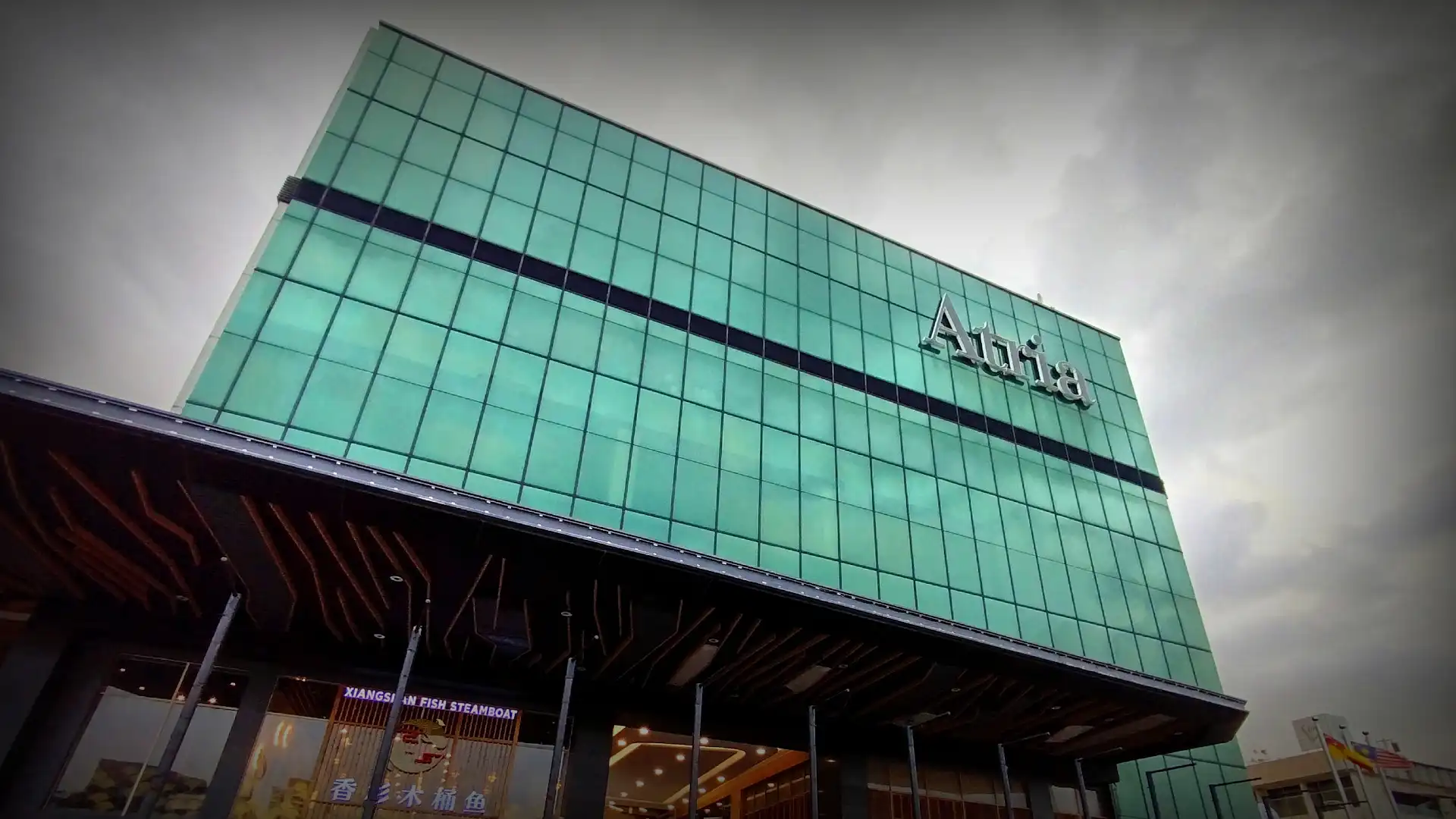
Atria Shopping Gallery is a four-level shopping complex located at Jalan SS22/1, Damansara Jaya (Section SS22), in Petaling Jaya, Selangor.
It sits at the heart of one of Petaling Jaya’s oldest and most characterful mature townships — a predominantly Malaysian Chinese, upper middle-class community established in the mid-1970s.
With a freehold land area of 236,806 sq ft (22,000 m²), the Atria site is one of the few genuinely freehold commercial plots in the western Petaling Jaya corridor, a fact that has shaped its decades-long story of reinvention.
What makes Atria unique in the Klang Valley mall canon is its bifurcated identity: a beloved, now half-forgotten 1980s shopping destination (once competing head-to-head with the finest department stores in the Klang Valley) and a 2015 reborn urban landmark serving Damansara Jaya’s loyal, established residential community.
Its story is inseparable from the story of Damansara Jaya itself — one of Petaling Jaya’s most cohesive, well-served, and politically significant neighbourhoods.
Established 1975 by Paramount Garden (See Hoy Chan Sdn Bhd Group), covering 1.21 km² with ~12,000 residents in ~2,000 dwellings (1,538 terraced houses, 179 semi-detached, 42 bungalows).
The Original Atria
Petaling Jaya’s Premier Department Store Destination (Mid-1980s):
When The Atria opened in the mid-1980s, it arrived into a Petaling Jaya that was still defining its retail identity.
The complex was designed as a four-level shopping centre with two three-level parking buildings — ambitious for its time — and its opening tenants set a benchmark for aspirational suburban retail: Kimisawa, a Japanese department store, and Printemps, a French department store.
The pairing was unusual and cosmopolitan: two very different retail cultures under one roof, reflecting the international ambition of the Damansara Jaya development.
Between 1984 and 1985, Atria was at its peak.
Weekend traffic congestion on the roads leading to Atria became a recurring spectacle — the Japanese and French stores would run simultaneous sales promotions that drew crowds from across Petaling Jaya and beyond.
Atria was genuinely considered a “must-visit” destination, competing with — and in the view of many locals, outperforming — other established PJ retail names such as Asia Jaya, Thrifty Supermarket, and Jaya Shopping Complex.
Social life at Atria was not limited to shopping.
The Piccadilly Disco — occupying the side entrance of the complex — was the social epicentre for teenagers and college students across western PJ.
Famous for its afternoon tea dances and its electric atmosphere, the disco was legendary — though also notorious for frequent police raids.
The Piccadilly Disco closed alongside the department stores during the late 1980s recession. By 2008, its former space had been converted into a language centre.
Decline, Multiple Ownership
Failed Redevelopment Attempts
The late 1980s recession that swept Malaysia struck Atria hard. Both Kimisawa and Printemps closed their doors, and the Piccadilly Disco shuttered soon after.
The complex — built on ambition but exposed by economic downturn — went into a prolonged decline.
Ownership changed hands several times over the following two decades, a common pattern for aging suburban malls that lose their anchor tenants.
By the early 2000s, Atria was struggling to compete with the newer, larger malls that had emerged in the surrounding area — 1 Utama to the north, The Curve and IPC Shopping Centre in Mutiara Damansara, and others.
The then-owner, Lien Hoe Corporation, decided to pursue redevelopment, but faced an insurmountable challenge: retaining tenants in a mall whose reputation had faded.
The redevelopment plan stalled, and Atria continued to operate at reduced capacity in an increasingly competitive market.
The OSK Property Redevelopment
From Demolition to Rebirth (2007–2015)
In 2007, OSK Property Holdings Bhd acquired the Atria site and initiated the most ambitious chapter in the complex’s history.
The original redevelopment plan called for a 33-storey office tower with a retail podium — a dramatic vertical transformation of the low-rise 1980s structure.
This plan was later revised — the tower concept abandoned in favour of a more pragmatic four-storey retail podium with two office towers.
The existing mid-1980s structure was fully demolished in 2011, and after four years of construction, the reborn Atria Shopping Gallery reopened in 2015 with significantly more retail space and parking bays than its predecessor.
| Location | Jalan SS22/1, Damansara Jaya (SS22), Petaling Jaya, Selangor, Malaysia |
|---|---|
| Coordinates | 3°07′39.4″N 101°37′21.95″E (3.127611°N, 101.6227639°E) |
| Original Complex | The Atria — opened mid-1980s; briefly called Gardenia Town Centre |
| Original Anchors | Kimisawa (Japanese dept store) + Printemps (French dept store) |
| Social Landmark | Piccadilly Disco (1984–late 1980s) — afternoon tea dances, teenagers & college students |
| Redevelopment Acquired | 2007 — by OSK Property Holdings Bhd |
| Original Complex Demolished | 2011 |
| Rebuilt & Reopened | 2015 — as Atria Shopping Gallery |
| Freehold Land Area | 236,806 sq ft (22,000 m²) |
| Structure | Four-level shopping complex + two 3-level parking buildings |
| Nearest MRT | KG09 Phileo Damansara (MRT Putrajaya Line) |
| Road Access | Federal Highway; Damansara–Puchong Expressway (LDP) |
| Postal Code | 47400 Damansara Jaya |
| Website | www.atria.com.my |
The Reborn Atria Shopping Gallery
(2015–Present)
The 2015 reopening marked a new era for Atria. The reborn complex — rebuilt on its freehold land — brought four levels of contemporary retail back to the heart of Damansara Jaya.
The new Atria positions itself as the community mall for Damansara Jaya and the surrounding established neighbourhoods, offering a mix of grocery, dining, services, and lifestyle retail that suits its predominantly residential catchment.
Atria’s competitive advantage is not scale — it does not try to compete with the Klang Valley’s mega-malls.
Instead, it offers something increasingly rare: a convenient, mature, and genuinely local mall where the parking is manageable, the crowd is familiar, and the tenant mix is built around the routines of daily life rather than weekend spectacle.
This is a mall for people who live nearby and return repeatedly — not for those who make a once-a-year pilgrimage.
Connectivity & Accessibility
Federal Highway Frontage & MRT Nearby:
★ By Road
Atria Shopping Gallery sits on Jalan SS22/1 at the centre of Damansara Jaya’s commercial strip.
Road access is via the Federal Highway — the primary north-south artery connecting KL, Petaling Jaya, Shah Alam, and Klang — and the Damansara–Puchong Expressway (LDP), which provides an alternative east-west corridor from Mutiara Damansara and Puchong.
The combination of Federal Highway frontage and LDP connectivity makes Atria accessible from most of the western Klang Valley by car.
★ Nearest MRT
Phileo Damansara (KG09) MRT station on the MRT Putrajaya Line is the nearest rail connection — an e-hail or short feeder ride away.
The MRT Putrajaya Line runs from Kwasa Damansara in the north through Bandar Utama, Mutiara Damansara, and Phileo Damansara, south to Putrajaya.
★ Parking
The two three-level parking buildings provide substantially more parking than the original 1980s complex — addressing one of the key criticisms of the original Atria (traffic congestion and parking stress during peak periods).
Damansara Jaya
The Township Atria Calls Home
Political Significance
A Township That Produces Leaders
Damansara Jaya punches well above its size politically.
The township and its immediate neighbourhood have produced several prominent Malaysian politicians.
Most notably, Tony Pua Kiam Wee — who would become Federal Finance Minister II under the Pakatan Harapan government — served as MP for the area from 2008 to 2018.
The current MP is Gobind Singh Deo (P.106 Damansara), a senior DAP figure.
At the state level, the area is represented by Jamaliah Jamaluddin (Bandar Utama, N.36), re-elected in the 2023 Selangor state elections.
This political depth reflects the demographic: an engaged, educated, and upper middle-class constituency that has been politically consequential for decades.
Conclusion
Atria Shopping Gallery’s story is one of the most remarkable in the Klang Valley retail canon.
Born as The Atria in the mid-1980s — with Kimisawa, Printemps, and the legendary Piccadilly Disco — it was briefly Damansara Jaya’s spotlight, drawing weekend crowds that gridlocked the neighbourhood.
The late 1980s recession ended that chapter; decades of ownership churn and competitive pressure followed.
Then came OSK Property Holdings, the 2007 acquisition, the revised redevelopment plan, the 2011 demolition, and the triumphant 2015 reopening on freehold land.
Today, rebuilt and reborn, Atria Shopping Gallery serves the ~12,000 residents of Damansara Jaya — a predominantly Malaysian Chinese, upper middle-class community that has lived here since the 1970s and has finally been rewarded with a mall that matches their loyalty.
It is not the biggest mall in the Klang Valley. But for the people of DJ, it is the most theirs.